


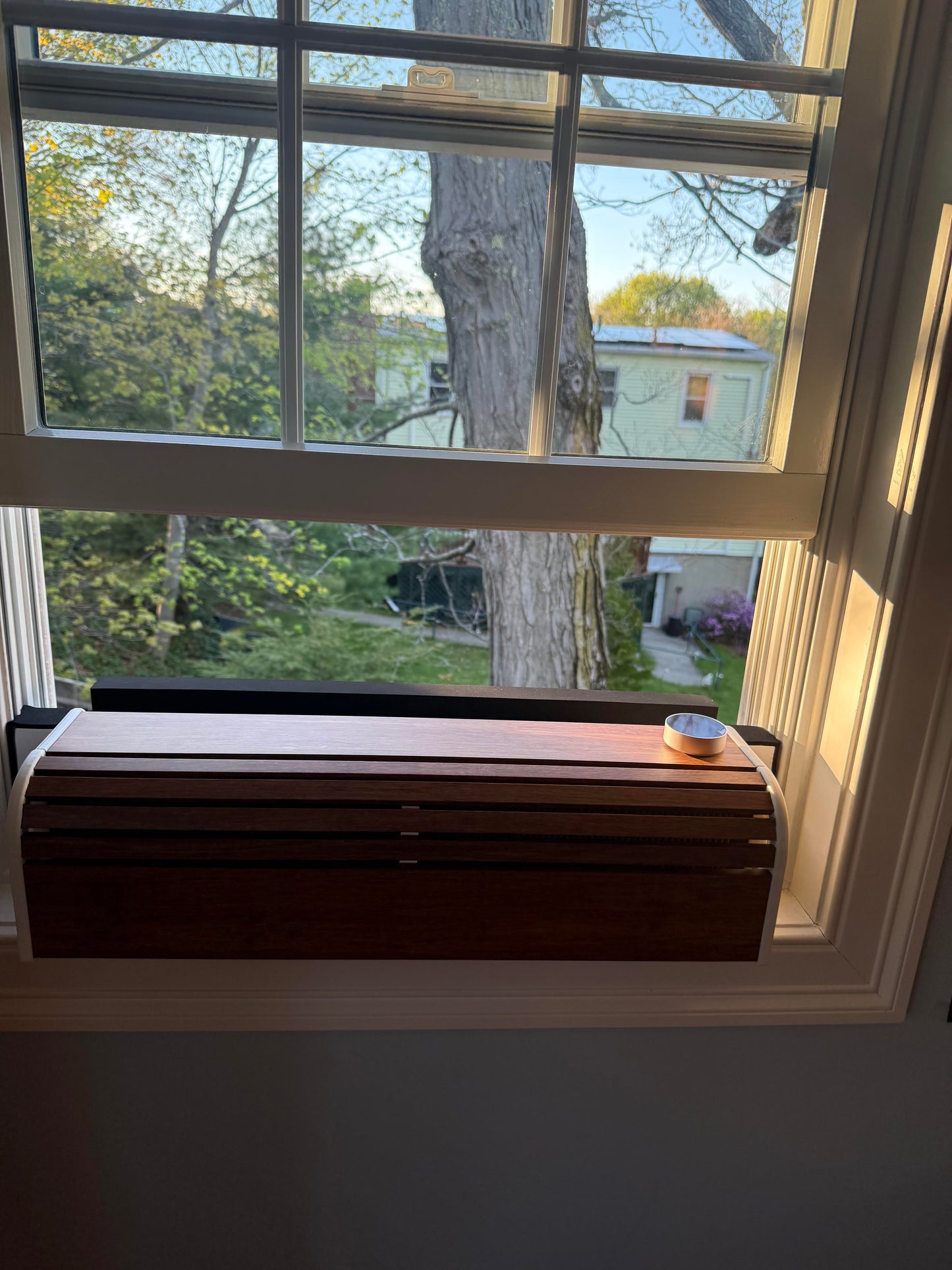
Installation was super easy and I love my SWERV.
I've been using my WHOOP to track my sleep data and I'm curious to see how my SWERV impacts my sleep long term!
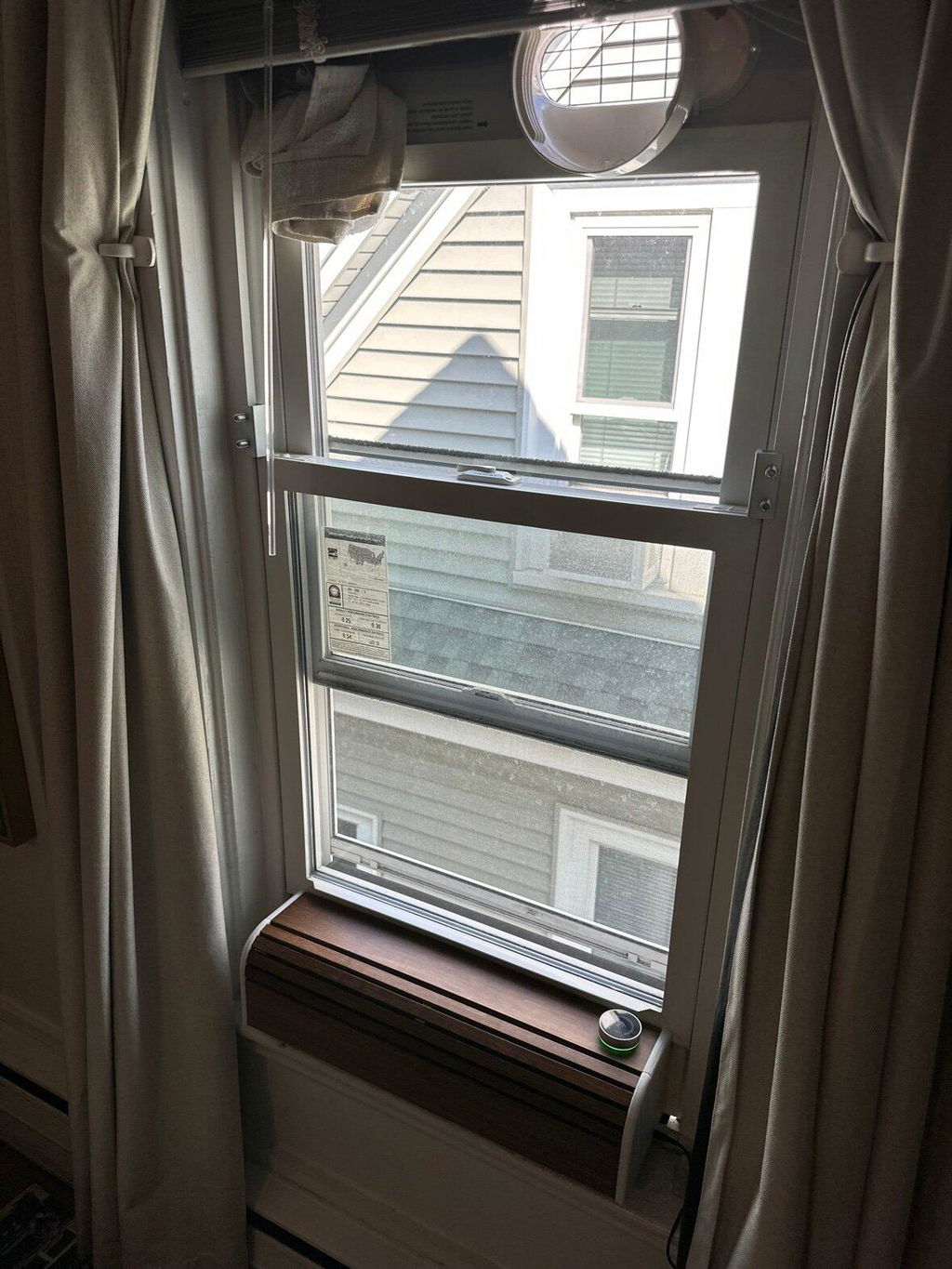
Drastically dropped co2 in the bedroom we sleep in. We both sleep much better now. Previously we would get up to 3300 ppm co2, the room now stays at about 1000, with two people and three dogs. The regen cores make a huge difference in comfort as well, you could hardly tell it was on even when it’s 98 outside.
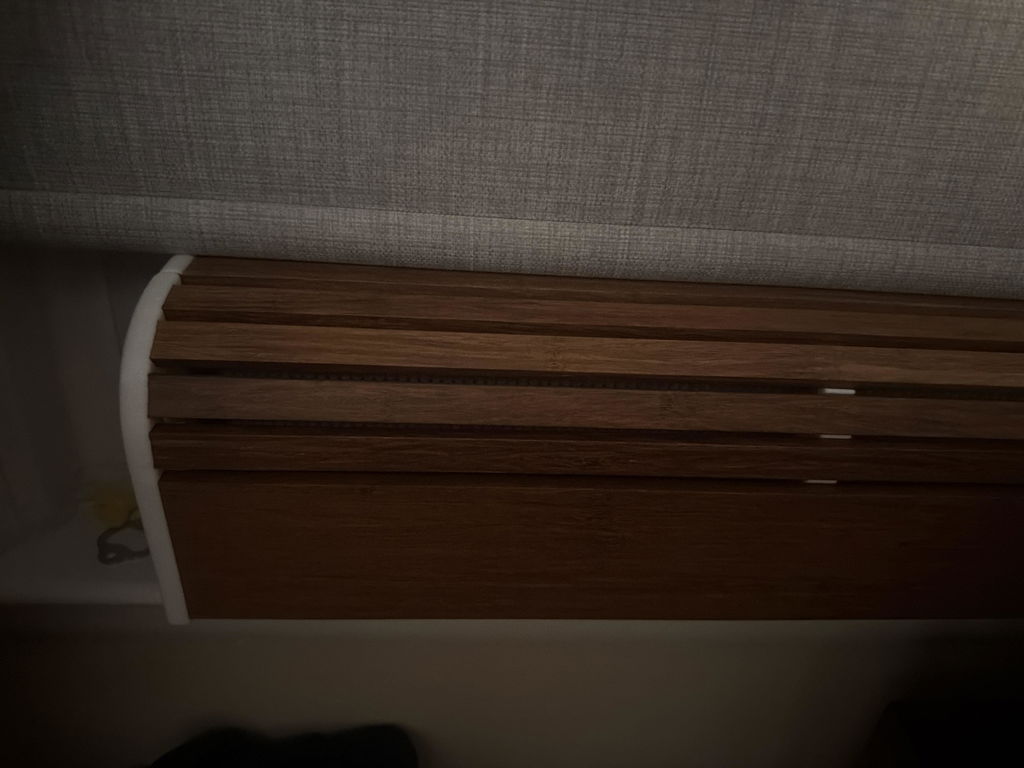
Bottom line up front: if you want an efficient ERV that is reasonably quiet and can actually be installed in a rental, there is nothing else like this on the market. I have had mine for about five months, it was expensive, and I don't regret buying it.
Some context, because it colors everything below: I have a one bedroom apartment, but a large one at 900 square feet.
CO2 performance. I was hoping for a more dramatic reduction than I got. My overall average CO2 is definitely lower, by roughly 100 to 200 ppm, call it about 25% below where it used to sit. I had also hoped it would almost entirely offset cooking on my gas stove, and it doesn't. It knocks the cooking peaks down by about 25%, and it brings them back down two to three times faster than before, which is genuinely useful. But even running flat out, CO2 still climbs higher than I would like. Again, that is a lot of apartment for a single unit. I suspect two of them would get me where I want to be, and I plan to add a second when I can.
Noise. At full power it is loud. Not unbearable, but it is roughly like having a box fan running at full speed: clearly noticeable, and not something I want humming in the background all day. I normally keep it around 60% to 70%. So there is a real compromise here, at least at my square footage: the apartment wants full power, and full power is louder than I want to live with.
Build quality. Mine is a pre-production unit and the quality is great for what it is. I have had pre-production hardware before, and this is as good as anyone could reasonably expect. They have clearly put a lot of thought and care into it, and I would expect the production units to be every bit as good. They also plainly know what they are doing on the engineering side. As an ERV, it works, no question, and it is a solid design given the constraints.
Who I would recommend it to. If you are in a smaller space, this is an easy recommendation. I would have loved to have one in a dorm room, especially anywhere with big temperature swings. If you have a large space, temper your expectations: it is not going to act as a whole home ERV, or even fully cover a large apartment on its own. It will still move the needle toward lower CO2, and that is worth a lot.
I went back and forth on returning it and ultimately kept it, because I get enough value out of it and because there is simply nothing else in this class to compare it to. I am looking forward to seeing what they improve from here.
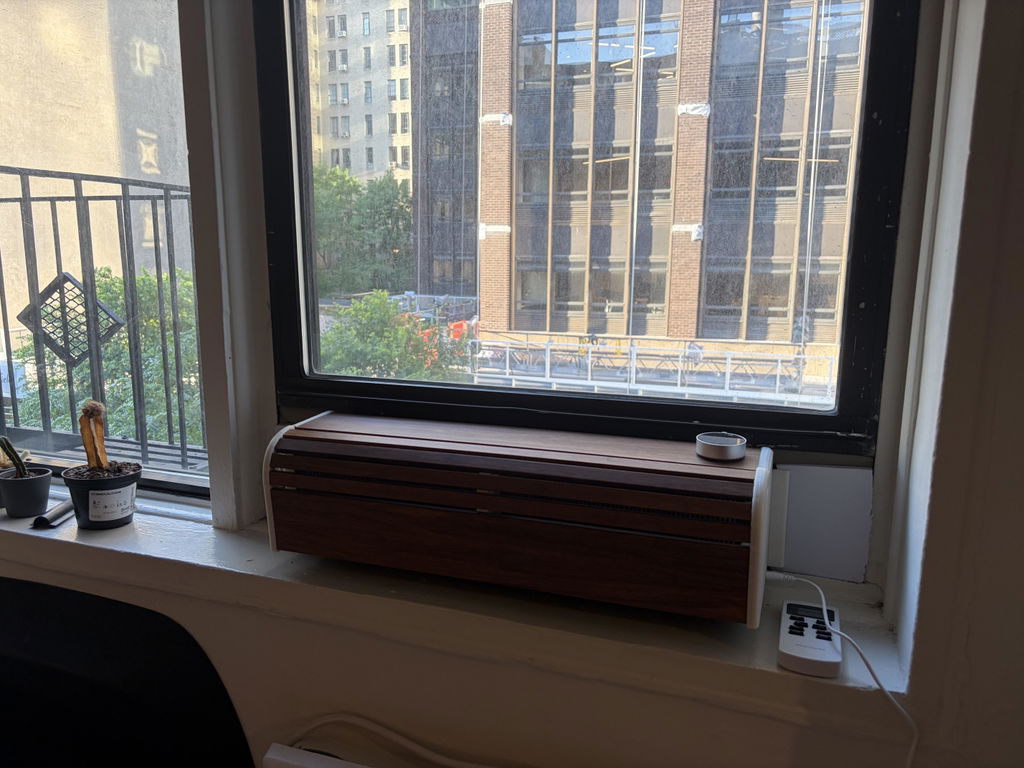
Truly an amazing window ERV that is one of a kind in its market in the US. It is quick and easy to install and very solid sitting in the window. Even only at about half power, it successfully dropped our average CO2 in our bedroom by over 600 ppm. We no longer get regular headaches.
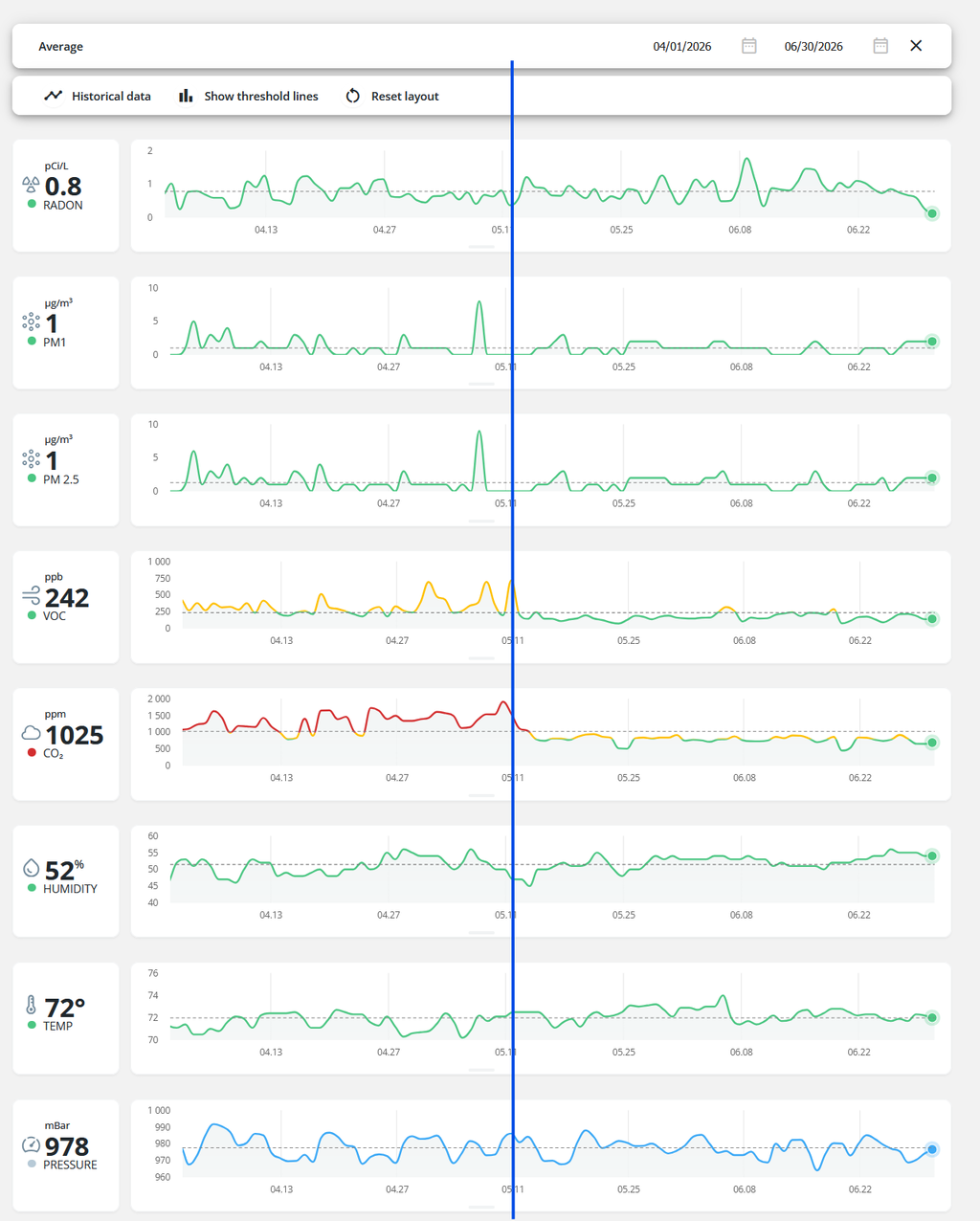
This product is simply excellent at reducing CO2. I use to manually vent with a window fan twice daily introducing a spike in temperature, humidity, pollutants, etc... in the process. It's not too hard to install, effortless to manage daily, and gets the job done easily justifying every penny spent. I highly recommend Swerv for your CO2 problems.
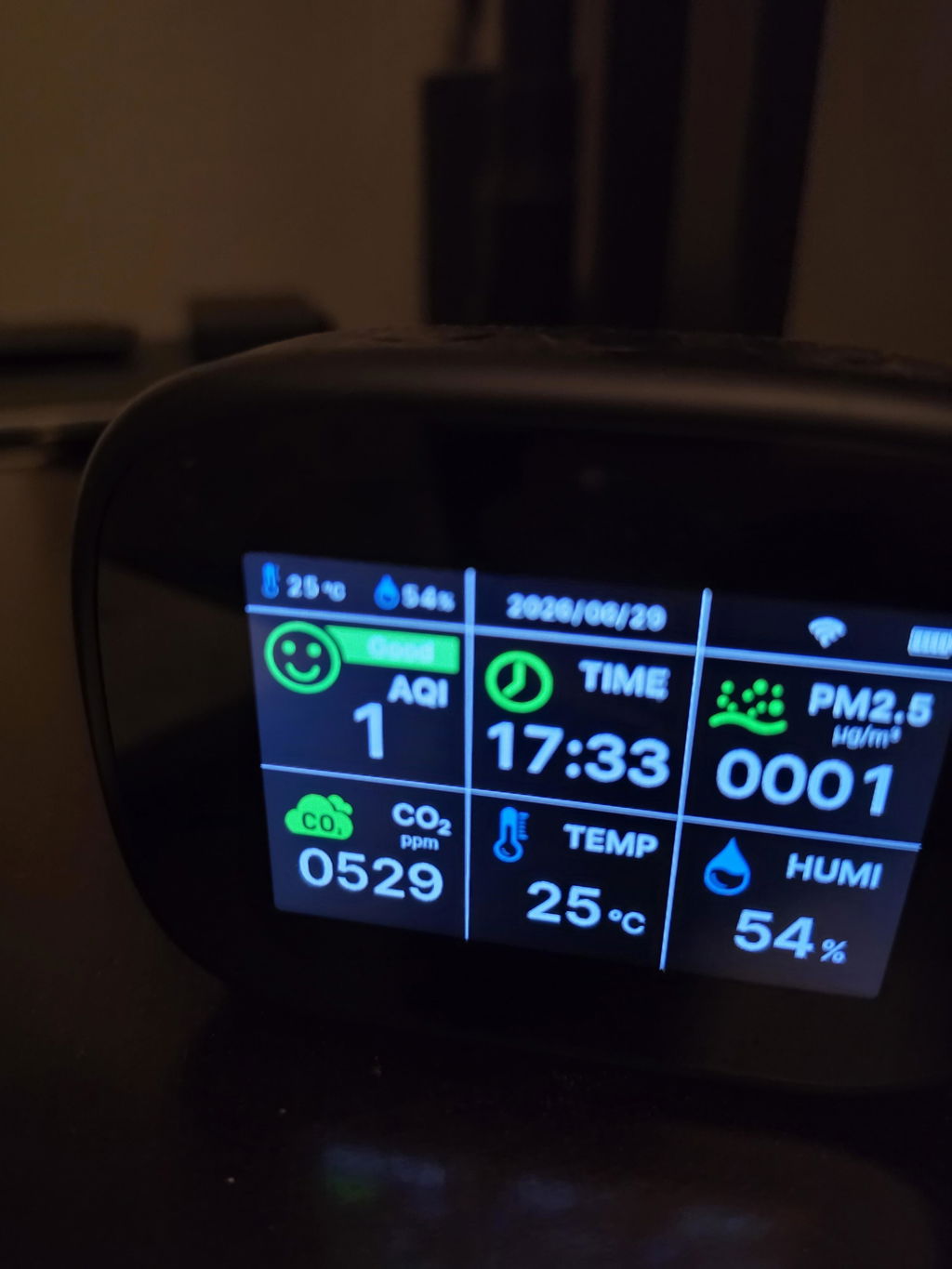

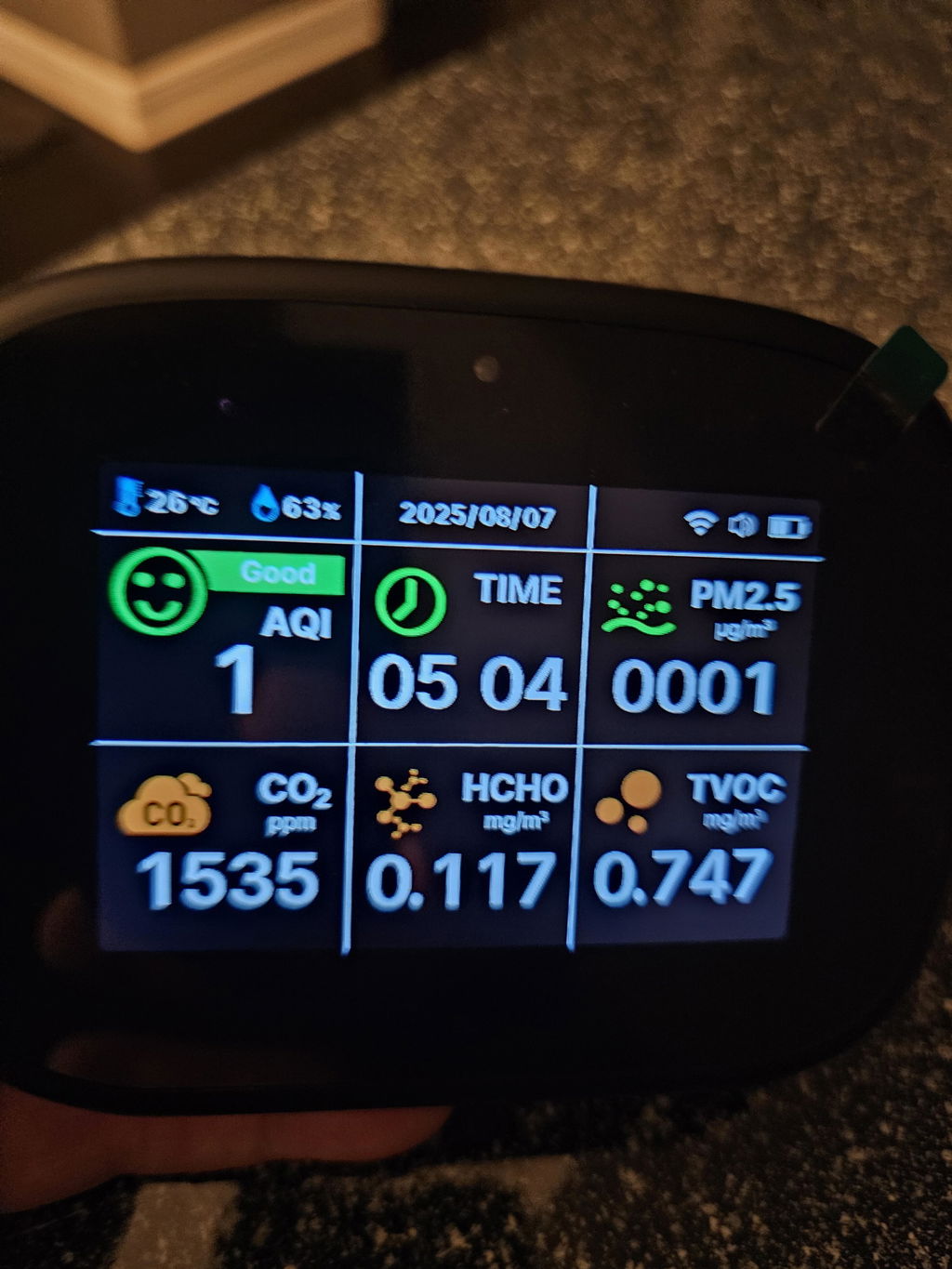
This definitely proved its worth during the recent poor air quality from the Canadian wild fires. I'd like to see the control knob somehow moves elsewhere so I can lower the blinds above it more. I also think the filter needs to be larger to be more cost effective and improve airflow. I feel limited to about 50% fan speed because the pitch of the fans at higher speeds is too unpleasant.
So far, it seems to be working well. It took a bit of fiddling to get it installed and make sure the gaps were all closed, but once that was done it has run smoothly so far. I am curious to see how well it works in the winter and how long the foam around it last.
Amazing :)
Real Customer Stories + CO2 Data
Josh
The SWERV beta unit has had a significant and noticeable impact on air quality. Before, our bedroom was peaking at over 1900ppm CO2. The average CO2 after install is now 784ppm.
We have had much better sleep overall. The most notable change is that we rarely have headaches when we wake up. The reduction in headaches alone has been amazing.


Alex L.
I used to keep my bedroom window open at night so CO2 wouldn't build up, which meant light, noise, and sometimes bad air. Now I can keep the window closed and still get good air, generally under 1000ppm.
My bedroom is much darker now and outside noises don't bother me as much.


Ann M.
I used to struggle to keep CO2 below 1400. Now even on humid days with no wind, I can keep it around 700-800ppm.
I no longer worry about the CO2 levels in my studio apartment, which has no exhaust vents.

Ilan R.
I'm now able to have a lower CO2 environment on days where I have to keep my windows closed.
I'm better at critical thinking on days where my windows have to be closed.

Blake M.
I now maintain between 600-800ppm with all the windows closed and my home is much quieter and cleaner.
The big change has been having a quieter environment. It also gets pretty cold here, but the ERV has allowed me to control the indoor climate much more effectively than before.


Michael J.
CO2 levels stay lower overnight.
Air feels fresher.


Herb R.
When temperatures and humidity are mild I put the switch to fresh-air mode and we get fresh air at minimum noise, and it's adjustable. When it gets hotter or colder I use ERV mode and we get fresh air while recovering energy.
I feel a bit fresher and better rested in the morning since the unit is in the bedroom. It probably is helping me sleep more comfortably.

Chris S.
Install was straightforward. Even with three people and two dogs in the room and the windows closed, it held CO2 around 1000ppm. I'm looking forward to really putting it to work once it's too hot to keep the windows open.

Eric S.
It brought in fresh air, and the install was easy. It went right into the window with no modification, and the instructional video was helpful.

Remington A.
It's been incredible. CO2 averages around 400-600ppm throughout the house with one unit at 26-40%. We were only able to achieve these levels if we were both out of the house at the same time.
My girlfriend and I have been able to do hard workouts on our Tonal for weeks without feeling sick. It's the first time I feel like I can actually use it again.


Paul N.
After cooking, CO2 comes down in under an hour instead of the 3 to 5 hours it used to take. Hallway smells barely register now, and the apartment just feels fresh with no lingering odors.
My peace of mind has improved, and smells bother me a lot less than before.


Gene W.
CO2 is consistently in the good range. I'm thrilled with how effortless this product is even running 24/7/365.
Swerv normalized my environment with constant true ERV filtered air. Once installed, Swerv is effortless. All you do is set it and forget it. There's no going back for me.


Drew R.
My windows are open a lot less now, and it even seems to slightly reduce my AC runtime. While I was away with it running at 40%, my CO2 stayed around 500 to 650ppm.


Siddha T.
After turning power up to 100%, the air doesn't feel stuffy anymore and CO2 is consistently well under 1000.
My sleep and general mental performance is better.


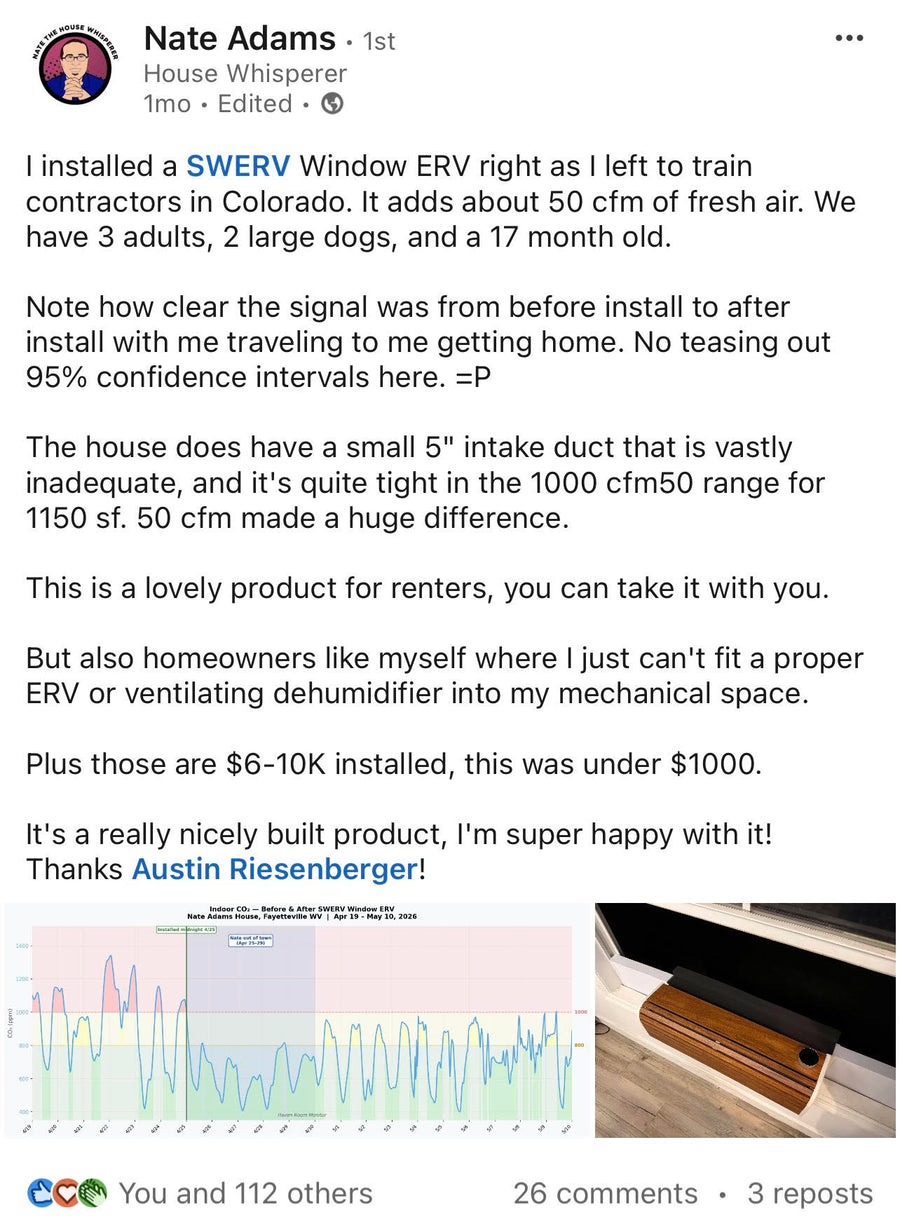
Jeff D.
No longer a tradeoff, good and fresh air year round with more comfortable temperature gradients without constantly managing it all day.
I now have good quality air without thinking about it all day long. Just turn it on!


Stella Y.
CO2 used to hit 1600 overnight. Now it's consistently around 900.
Our air is a lot fresher.

Matt C.
CO2 can be kept below 1000 ppm. Also helps eliminate particulates.
General improvement in air quality.


Jesse M.
Before SWERV I ran a big fan at max all day, which meant a humidifier in winter and a dehumidifier in summer. Now my humidity stays stable without any of that, and my mini split keeps the house cool even at 90 degrees and 80% humidity.
It's doing a good job, and with a second unit I think my problem would be completely solved.

Frequently Asked Questions
What is SWERV and how does it work?
SWERV V3 is a window-mounted ERV (energy recovery ventilator). It brings fresh, filtered outdoor air into your room and sends stale air out, while recovering about 85% of the heat and moisture so you don't lose your heating or AC. The fans push stale room air out through a ceramic core, which captures the heat on the way out. Then the airflow reverses and fresh air comes in through the warmed core and picks that heat back up. This repeats every 45 seconds or so. ERVs are standard in high-performance buildings, and SWERV brings that to one room with no ductwork or construction.
When will SWERV V3 ship?
Batch 3 (SWERV V3) is targeted to ship in January 2027, in the order orders are placed. We'll email you before yours ships, and you can cancel anytime before it ships for a full refund.
How is it different from an air conditioner or air purifier?
Both of those recirculate the air already in your room. An AC cools it but brings in nothing fresh. A purifier filters out particles but can't remove CO2 or the odors that build up overnight in a closed bedroom. SWERV actually swaps stale indoor air for fresh outdoor air, filtered through a MERV 13 + activated carbon filter, while the core keeps your heating or cooling energy inside. It works alongside your AC or purifier, not in place of them.
Will it fit my window?
SWERV fits double-hung, single-hung and horizontal sliding windows at least 23" wide that open at least 6". Windows wider than 48" work too, just email support@swervair.com and we'll send extra foam blocks free. The window needs to open and close smoothly and have a solid frame and sashes. It doesn't fit casement, awning or tilt-open windows, doors, or any opening that can't be closed securely onto the unit. Not sure? Send us a photo and we'll tell you.
How loud is it?
About 35 dBA at the lowest setting (10% speed), about 50 dBA at 50% speed, which is where most people sleep, and about 59 dBA at 100%, all measured at 1 meter. At sleep speeds it sounds like steady airflow, not a mechanical hum. Full speed is a boost for fast air exchange, not for overnight. V3 has new fans and a new core that run quieter than our earlier beta units, and over-the-air updates keep smoothing out the sound when the airflow flips.
How easy is it to install?
Much easier than a window AC. A window AC is a 50 to 80 lb two-person job with brackets and screws. SWERV weighs about 19 lbs and installs more like a window fan: set it on the sill, close the window down onto it, done. Most installs take 10 to 15 minutes, one person, with tools you already have (a sharp knife, cutting board, scissors and a ruler). No drilling, no screws, no permanent changes. The one step that takes care is trimming the two foam side blocks to length, since a straight, square cut is what locks the unit in and seals it. The installation guide walks you through it.
How much energy does it use?
Very little. At typical speeds it draws about 10 watts, about the same as a Wi-Fi router. Even at max speed it's 42 watts. Running it all night costs about a penny at average US electricity rates, or a few dollars a year.
Is SWERV UL certified?
Not yet. SWERV V3 is designed to UL 1815, the safety standard for ductless heat recovery ventilators, and it's in the certification process now. We can't promise a date, so your unit may or may not ship certified. After you order you can take an earlier unit (first come, first served) or wait for a certified one. If your landlord, building or insurance requires UL certified appliances, tell us and we'll hold yours until certification is done.
What does "beta" mean, and what's expected of me?
SWERV V3 is a real, working product built in small batches by our team near Boston. It's still called beta because it isn't UL certified yet. You get early access and a direct line to the engineering team, and your unit keeps improving with over-the-air updates. In return, we ask that you read and accept the Paid Beta Program Agreement before use, follow the installation guide carefully (including staying present for the first 10 minutes of operation), and share honest feedback. If you hit an issue, contact support with your order number, photos and a short description.
What's the warranty and return policy?
SWERV V3 comes with a 5-year limited warranty: if something fails in normal use, we repair or replace it. You also get free 30-day returns from delivery, and you can cancel anytime before your unit ships for a full refund.
How often should I replace the filters?
Replace the 2-in-1 MERV 13 and carbon filter every 4 to 12 months, depending on your outdoor air and how hard you run it (closer to 2 to 4 months if it's venting a kitchen). Check it every 30 days for the first few months to learn your home's dust load. Rinse the stainless steel outdoor pre-filter about once a year.
Will replacement filters still be available years from now?
Yes, and it's a fair thing to ask an early-stage company. The SWERV filter is custom to the unit. We tested filters from more than 20 manufacturers before picking this one because it gave the best mix of MERV 13 filtration, activated carbon, surface area and low pressure drop.
We hold a large inventory and sell replacements on our site. If SWERV ever stopped supplying them, we'd tell customers directly, release our remaining stock at a steep discount or free, and give owners the specs and manufacturer contact to order compatible filters straight from our filter partner. You won't be left with a unit you can't maintain.
We're also exploring a washable prefilter that only needs a rinse every 3 to 6 months. It wouldn't catch smoke, pollen or odors like the current filter does, but it would be another way to keep the unit running.